
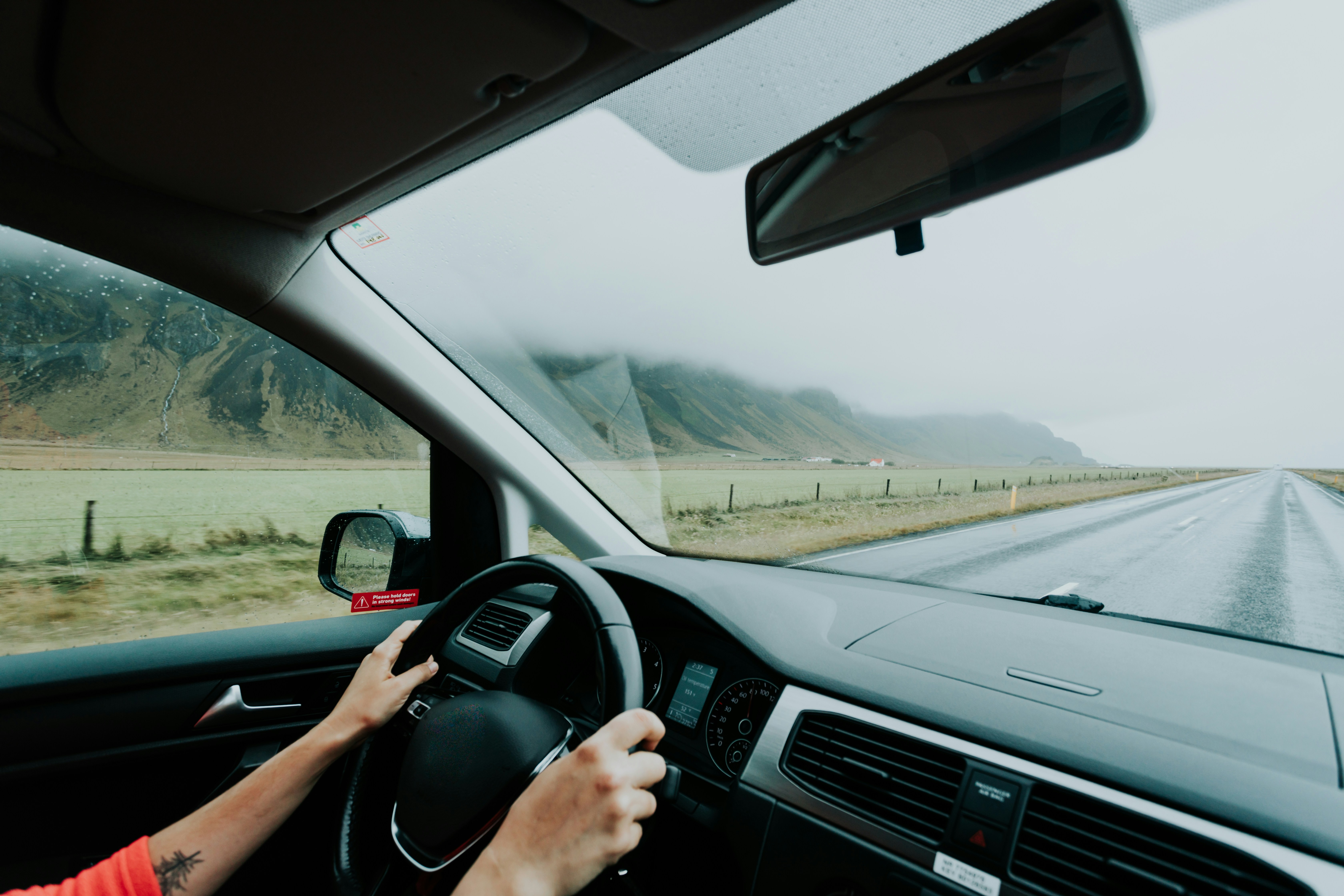
We need to talk about driving on the Isle of Skye. Not because we want to discourage you from visiting one of the most hauntingly beautiful places in Europe, but because we have watched too many clients return from Scotland with stories that involve white knuckles, scraped rental cars, and arguments with their travel partners that started somewhere on the road to Neist Point and did not fully resolve until they were safely back in Edinburgh. The Instagram version of a Skye road trip is a convertible gliding along a coastal road with the Cuillin mountains in the background. The reality, particularly for Americans who have never driven on the left side of the road, is considerably more stressful.
Left-Hand Traffic Is Just the Beginning
Driving on the left sounds simple enough in theory. You tell yourself you will adapt quickly, and for the first thirty minutes on a wide motorway leaving the airport, you probably will. The car feels strange, the turn signals are on the wrong side of the steering column, and you keep reaching for a gear stick that is not where your muscle memory expects it to be, but you manage. The trouble starts when you leave the main roads, which on Skye happens almost immediately.
Left-hand driving requires constant, active concentration in a way that right-hand driving in America simply does not, because everything you do behind the wheel at home is automatic. On Skye, every roundabout, every junction, every moment when a car appears in front of you and you need to decide where to position yourself, demands a conscious decision. Your instincts are wrong, and they will stay wrong for the entire trip unless you are spending weeks in the country. Fatigue sets in faster than you expect, and fatigue on a narrow Highland road with a sheer drop to a sea loch on one side is not the same as fatigue on an interstate.
We see this pattern repeatedly. A client books a rental car because it seems like the obvious, independent, adventurous choice. They drive from Inverness to Portree on the first day and it goes reasonably well because the A87 is a proper two-lane road for most of its length. They feel confident. Then on day two, they head for the Quiraing or the Fairy Pools, and the roads change character completely. That is when the real difficulty begins.
Single-Track Roads and Passing Places
Much of Skye is served by single-track roads. These are exactly what they sound like: one lane of tarmac, wide enough for one vehicle, with small gravel pull-offs called passing places positioned every few hundred meters. When you see a car approaching from the opposite direction, one of you needs to pull into the nearest passing place to let the other through. If the passing place is on your left, you pull in. If it is on your right, you stop and let the oncoming car pull in. It is a system that works beautifully when everyone understands the etiquette. It works considerably less well when one of the drivers is simultaneously trying to remember which side of the road they should be on.
The problem is compounded by the terrain. Many of Skye's most scenic roads twist through hills and along cliff edges with limited visibility. You come around a blind corner and there is a campervan bearing down on you, and you have perhaps two seconds to spot the nearest passing place and execute a maneuver that requires reversing on the left side of a road that is barely wider than your car. Local drivers do this with the casual ease of someone parallel parking in their own driveway. They flash their lights, wave thanks, and carry on without breaking stride. For an American driver experiencing this for the first time, at speed, in the rain, it can be genuinely frightening.
There is also the matter of the passing place etiquette that tourists frequently misunderstand. Passing places are not parking spots. They are not photo pull-offs. They are not picnic areas. Using them for anything other than passing creates a bottleneck that frustrates locals and fellow travelers alike. We mention this not to be preachy but because we have heard from multiple clients that they did not understand this until someone honked at them, which is a remarkably aggressive act by Scottish standards and an indication of genuine irritation.
"I consider myself a good driver. I've driven in Italy, in Costa Rica, in the Australian outback. Nothing prepared me for the road to the Old Man of Storr in August." — An Ember Travel Client, 2024
The Fairy Pools Parking Problem
Even if you master left-hand driving and become comfortable with single-track roads, Skye has another challenge that no amount of driving skill can solve: parking. The island's most popular attractions were never designed for the volume of visitors they now receive. The Fairy Pools, arguably Skye's most famous single attraction, has a small car park that fills completely by mid-morning during the summer months. When the car park is full, visitors park along the road, on the grass, in passing places, and in any other space that a vehicle can be wedged into. The result is a chaotic scene that blocks access for emergency vehicles and local residents, and has led to increasing tensions between the tourism industry and the island's permanent population.
The Old Man of Storr faces similar issues. The Quiraing is marginally better because the road loops, but it is also one of the most challenging drives on the island, with steep gradients, tight switchbacks, and exposure to crosswinds that can push a rental car sideways. Neist Point Lighthouse, Brother's Point, and the Coral Beach all involve narrow approach roads that become two-way bottlenecks when traffic is heavy. In peak season, you can spend more time looking for parking and navigating traffic jams than you spend at the actual attractions.
This is not a hypothetical concern. Highland Council and the Scottish Government have been actively working on infrastructure improvements, but Skye's roads were built for a resident population of around ten thousand people, not the half-million-plus annual visitors who now arrive. The gap between infrastructure and demand is real, and it falls disproportionately on self-driving tourists who do not know the workarounds.
Better Alternatives
None of this means you should skip Skye. It means you should reconsider how you experience it. The good news is that the alternatives to self-driving are not compromises. In many cases, they produce a better trip than driving yourself would, even if you were perfectly comfortable on the left side of the road.
A private driver-guide is, in our view, the single best way to experience Skye. These are local professionals who know every back road, every hidden viewpoint, and every timing trick that avoids the crowds. They know that you should visit the Fairy Pools at seven in the morning or five in the evening, not at noon. They know the unmarked pull-off above the Quiraing where you can photograph the entire ridge without another person in the frame. They know which pub in Portree actually serves good food and which one survives on tourist traffic alone. And critically, they handle all the driving, which means you can actually look at the scenery instead of gripping the steering wheel and staring at the road.
Private driver-guides on Skye typically work in full-day increments, collecting you from your hotel in the morning and returning you in the evening. The cost is higher than a rental car, obviously, but when you factor in the rental car itself, insurance, fuel, parking fees, and the very real possibility of damage charges for scrapes acquired on narrow roads, the gap is smaller than you might think. And the value of local knowledge, someone who can adjust the itinerary on the fly based on weather and crowd conditions, is essentially priceless.
Guided small-group tours are another strong option, particularly for solo travelers or couples who enjoy meeting fellow travelers. Several operators run full-day Skye tours from Inverness or Portree with groups of eight to sixteen people in comfortable minibuses. The itineraries are well-designed, the guides are knowledgeable and often deeply entertaining, and the logistics are entirely handled. You show up at the meeting point and spend the day being shown the best of the island without a single moment of driving stress.
For clients who want the most flexibility, we sometimes recommend a hybrid approach: base yourself in Portree or another Skye village and use a combination of private guides, group tours, and walking to explore. Portree itself is walkable, and several excellent hikes leave directly from town. The bus network on Skye is limited but does cover some key routes. This approach gives you the independence of being based on the island without the stress of driving its most challenging roads.
We arrange private driver-guides and guided Skye day tours for our Scotland clients as part of the overall itinerary. The best guides book out months ahead for peak season (June through August), so early planning matters. We also help with hotel selection on Skye itself, which is its own challenge given the limited supply of quality accommodations. Whether you want two days on the island or four, we will build an itinerary that gets you to every landscape you have dreamed about without a single white-knuckle moment behind the wheel.
Skye deserves to be experienced with your eyes wide open, both to its extraordinary beauty and to the practical realities of visiting a remote island whose fame has outpaced its infrastructure. The landscapes are everything the photographs promise and more. The light shifts constantly, painting the Cuillin mountains in shades that no camera can fully capture. The coastline is wild and varied, from the dramatic basalt columns of Kilt Rock to the gentle curves of Coral Beach. And the sense of history, from Dunvegan Castle to the ruins of crofting villages, gives the scenery a depth that pure natural beauty alone cannot provide.
You will love Skye. We just want to make sure the drive does not get in the way of that love. Let someone else handle the road, and give yourself permission to simply look out the window. That is what Skye was made for.